Two extension clients can want almost the same finished look and still need very different installation plans.
One may wear a high ponytail every morning. Another keeps her hair down almost all week. One wants soft fullness through the ends. Another wants a noticeable change in both length and density. Those details matter more than choosing the extension method that happens to be trending.
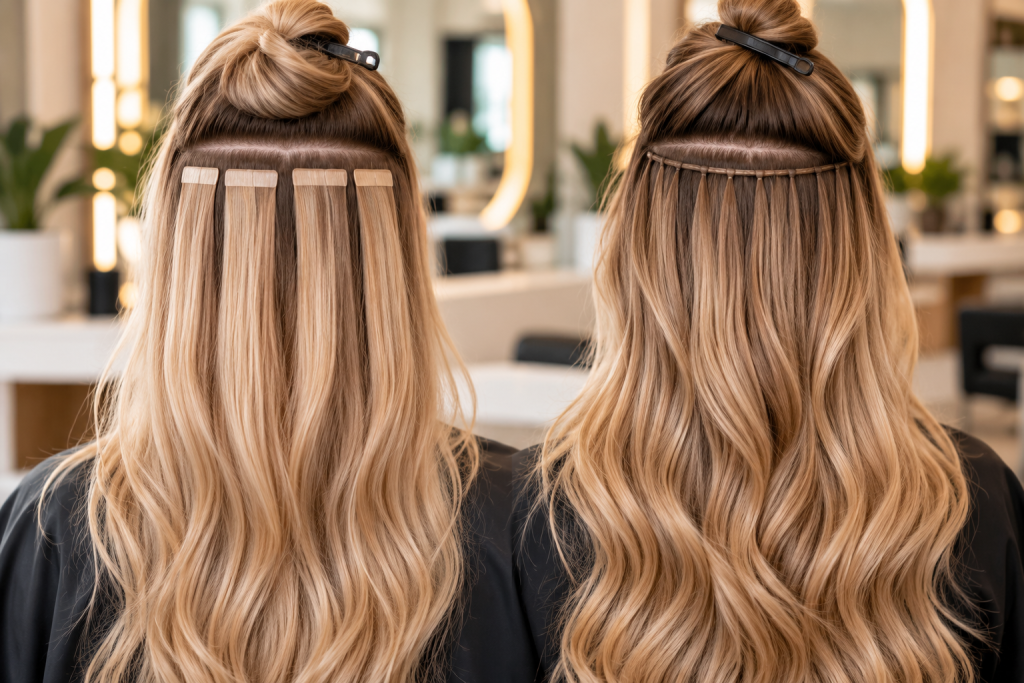
Tape-in and hand-tied hair extensions can both create longer, fuller-looking hair, but they attach differently and require different routines. Tape-ins use smaller adhesive sections placed through the hair. Hand-tied extensions use wefts positioned along planned rows. Neither method is automatically better for everyone.
The better choice is the one that fits the natural hair, desired result, styling habits, and maintenance commitment. For anyone comparing hair extensions in Cincinnati, understanding those differences before a consultation makes the conversation far more useful.
The Biggest Difference Is Not What You See After Styling
Once extensions are cut, blended, colored, and styled, two finished results may look surprisingly similar. Underneath the finished style, however, the attachment pattern is different.
Tape-ins spread the attachment points around the head
Tape-in hair extensions use thin sections of extension hair attached with adhesive tabs. A stylist can place those sections through different areas according to the client’s density, cut, and desired fullness. That distributed placement can be useful when the extension plan calls for adding hair in several selected areas instead of concentrating it along one row.
Hand-tied extensions build fullness along rows
Hand-tied extensions use wefts of hair rather than individual adhesive panels. The wefts are installed along carefully planned rows. This can create a different distribution of weight, fullness, and attachment points.
One detail is especially useful to understand: “hand-tied” refers to the way the weft is made. The salon’s installation technique determines how that weft is actually attached. That is why a consultation should go beyond asking whether a salon offers “hand-tied extensions.” Ask how the rows are positioned and how that placement will work with your own hair.
Your Daily Routine May Make the Decision Easier
The best extension comparison does not happen while looking at two sample wefts. It happens when you think about an ordinary Tuesday. How do you wear your hair for work? What happens at the gym? Do you change your part? Do you sleep with your hair up? Do you spend ten minutes styling or forty? These small habits can affect how satisfied someone feels with an extension method long after the first appointment.
If you wear your hair down most days
Both tape-ins and hand-tied extensions may be options.
The conversation becomes more about:
- natural density
- desired fullness
- attachment concealment
- amount of added hair
- maintenance preference
- how the natural ends will blend
A good haircut also matters because extensions should flow into the existing shape instead of looking like a separate layer underneath it. The salon’s guide on why haircut technique matters explains why shape and movement matter even before extensions enter the picture.
If ponytails and buns are part of your week
Tell your stylist before placement begins. High ponytails, low buns, half-up styles, and workout hair can expose areas that stay completely hidden when the hair is worn down.
Instead of asking only:
“Can I wear my hair up?”
A better conversation is:
“Where will the attachments sit when I wear my hair the way I normally do?”
That lets the stylist think about placement before the installation is complete.
If you regularly change your part
Mention this too.
Someone who always wears a center part has a more predictable concealment pattern. A client who switches between a deep side part, center part, and pulled-back styles may need more flexibility built into the placement.
Think About the Result Before Thinking About the Method
A surprisingly useful question is:
What do you actually want the extensions to change?
“Longer hair” is only one possible answer.
Fuller ends
Some clients like their current length but feel their ends look light or sparse. In that situation, the goal may be density rather than dramatic length. The extension plan can focus on supporting the shape that already exists instead of creating an entirely different silhouette.
More length with a natural blend
Adding noticeable length changes the blending challenge.
The stylist has to consider:
- how short the natural hair is
- how much extension hair is required
- the difference between natural and desired length
- existing layers
- density through the sides and back
- how the hair moves after styling
A larger transformation may require a different distribution of extension hair than a small volume adjustment.
Length and fullness together
This is often the most involved goal. Adding substantial hair means the stylist must think carefully about weight, concealment, color, and balance.
More extension hair is not automatically a better result.
Enough hair should be added to achieve the desired look while remaining suitable for the natural hair underneath it.
The “Mirror Test” Before Choosing Your Extensions
Before comparing maintenance schedules or attachment names, picture your hair in five real-life situations.
Look 1: Straight and smooth
Straight hair often makes the transition between natural hair and extensions easier to inspect.
Can the natural ends blend into the added length without an obvious shelf?
If not, the cut or amount of extension hair may need adjustment.
Look 2: Soft waves
Movement can help different lengths blend together, but color and density still need to feel balanced.
Clients who often wear loose curls or waves may also want to think about how much styling time they are comfortable with.
A professional blowout can create a polished finish, but everyday extension success should not depend on salon styling alone.
Look 3: High ponytail
Imagine lifting all of the hair away from the neck.
Where will the tapes or rows sit?
Would your favorite ponytail expose them?
Look 4: Half-up style
This removes some of the hair that normally conceals the extension attachments.
If half-up styles are common for you, they deserve to be part of the placement discussion.
Look 5: Your usual morning hair
This may be the most important one.
Extensions need to fit the way you actually live, not only the way your hair looks immediately after a salon appointment.
Wash Day Feels Different With Each Method
Installation gets most of the attention online. Home care deserves just as much.
Living with tape-in extensions
Tape-in wearers need to pay attention to the adhesive areas.
The routine may include:
- careful cleansing around the attachments
- keeping unsuitable oils and heavy products away from adhesive
- drying the roots and attachment areas thoroughly
- brushing without tugging at the tapes
- separating sections carefully when detangling
Living with hand-tied extensions
With hand-tied wefts, care shifts toward the rows.
That may involve:
- cleansing around and between the rows
- rinsing thoroughly
- drying the row area rather than leaving it damp
- brushing above and below the weft carefully
- preventing tangles around the attachment points
Neither routine needs to feel difficult once it becomes familiar.
But this is why an extension method should not be chosen based only on installation day.
The better method is also the one whose maintenance you are comfortable living with between appointments.
Maintenance Appointments Are Part of the Extension Plan
Natural hair continues to grow after extensions are installed. That means the original attachment position changes over time. For tape-ins, maintenance generally involves removing the adhesive sections, preparing them for reuse when appropriate, replacing adhesive, and repositioning the extensions closer to the scalp.
For hand-tied extensions, the stylist works with the growing row, repositioning or reinstalling it according to the system being used. The exact return schedule should come from the stylist rather than a universal number found online. Hair growth, extension method, home care, and installation technique can all affect timing. If this is your first extension experience, the salon’s guide to hair extensions for fine hair should also be connected here once that article is live. It explains density, attachment visibility, and what to consider before a first consultation.
Hair Color Can Quietly Decide Whether Extensions Look Natural
A perfect length match with the wrong color still looks like extensions. Natural hair rarely consists of one flat shade.
There may be:
- deeper roots
- lighter ends
- face-framing brightness
- highlights
- balayage
- warmer or cooler pieces
- different tones through the mid-lengths
This is why extension color selection should happen with the complete hair plan in mind. Someone considering hair highlights may need the highlight placement settled before the final extension shades are chosen.
The same applies to balayage hair color, where lighter pieces can move gradually through the lengths. If you are still choosing between those techniques, the salon’s guide to balayage vs. highlights gives a clearer picture of how each creates dimension. For clients planning a larger color change, highlights vs. full color is another useful place to start.
The important point is simple:
Plan the finished hair, not each service in isolation.
Four Extension Beliefs That Deserve a Closer Look
- “Tape-ins are always the best extensions for fine hair.”
Not automatically.
Fine strand diameter is only part of the picture. Overall density, breakage, desired result, attachment visibility, and the amount of added hair matter too. A person can have fine strands and still have plenty of natural density.Someone with very low density may need a much more cautious placement plan regardless of extension type.
- “Hand-tied extensions are better if you wear ponytails.”
Not automatically. Row placement still affects how easily extensions can be concealed in an updo. The hairstyle should be discussed before installation rather than assuming one attachment method will solve every styling challenge.
- “Extensions should feel exactly like natural hair immediately.”
They will feel different because additional hair and attachment points have been added. The important distinction is between becoming accustomed to extensions and experiencing ongoing pulling or discomfort that should be discussed with the stylist.
- “One extension method causes damage and the other does not.”
That comparison is too simple. Appropriate weight, installation, maintenance, brushing, home care, and professional removal all influence how extensions interact with natural hair. Clients combining extensions with services such as a keratin treatment should also tell their stylist so services can be planned in the right order.
A Better Way to Choose: Match the Method to Seven Parts of Your Life
Rather than making a pros-and-cons scorecard, think through these seven areas.
Your density.
How much natural hair is available to support and conceal attachments?
Your goal.
Are you after fuller ends, extra length, or a major transformation?
Your haircut.
Will your existing layers and shape blend smoothly with added hair?
Your styling routine.
Do you wear ponytails, buns, waves, straight styles, or several different looks?
Your part.
Do you keep one part or change it often?
Your maintenance tolerance.
Are you comfortable adjusting your washing, drying, brushing, and salon schedule?
Your stylist’s assessment.
What does the natural hair actually support once density, condition, and placement are evaluated in person?
Those seven factors are far more useful than choosing an extension method because a photo looked good online.
Where The Wild Hare Salon Fits Into the Decision
The Wild Hare Salon offers several hair extension options in Cincinnati, including tape-in extensions, hand-tied wefts, I-tips, keratin bonds, and volume-focused extensions. Rather than treating every client as the same extension installation, the decision can begin with the natural hair and the result the client wants to maintain. Someone may arrive expecting hand-tied extensions and discover that another placement makes more sense. Someone else may initially ask only for length and realize that fullness is actually the change they wanted.
That is why method selection works best after the hair, lifestyle, and finished look are considered together. Clients planning extensions alongside a new cut, color, smoothing service, or styling change can also explore the salon’s other hair and beauty services before building the complete appointment plan.