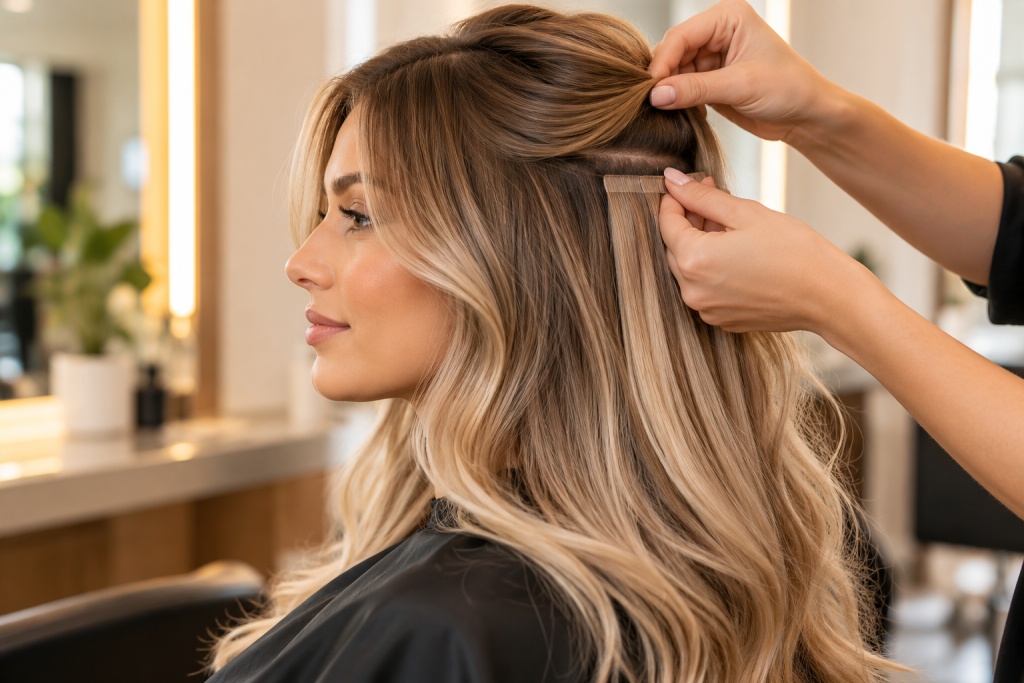
Fine hair does not automatically rule out hair extensions. The bigger question is whether your natural hair has enough density and strength to support the added hair comfortably, and which extension method fits the way you style and maintain your hair.
Someone with fine strands may have plenty of hair overall. Another person may have lower density, breakage, or areas where attachments would be harder to conceal. That is why choosing extensions from a photo or social media trend is rarely enough. A good first visit should help answer three questions: What can your natural hair support? What result are you trying to create? What level of maintenance fits your routine? At The Wild Hare Salon, clients can discuss these factors during a hair extension consultation before choosing an installation method.
Fine Hair and Thin Hair Are Not Always the Same Thing
People often use “fine hair” and “thin hair” to mean the same thing, but they describe different characteristics. Fine hair refers to the diameter of each individual strand. A person can have very fine strands but a large number of them. Low-density or thin hair means there are fewer strands in a given area. Someone can even have relatively thick individual strands while having lower overall density. That distinction matters when considering extensions.
A stylist looking at fine hair may consider:
- How much natural hair is available to support each attachment
- Whether attachment points can stay covered during normal styling
- Areas that are noticeably less dense
- Existing breakage or fragile sections
- Current hair length
- Texture and movement
- Previous color or chemical services
The goal should not be to choose a method simply because it is popular. The extension plan should start with the hair that will actually be supporting it.
Can You Get Hair Extensions With Fine Hair?
Yes, some people with fine hair can wear extensions, but the amount, method, and placement need to match the natural hair.
Extensions can be used for much more than dramatic length. Some clients want fuller ends. Others want more body through the sides or enough added hair to make their current cut look denser. The right recommendation depends on several factors that cannot be judged from an inspiration photo alone.
Natural hair density is especially important. More extension hair means more added weight and more attachment points. If the goal can be achieved with a lighter or more targeted plan, using additional hair simply because “more is better” may not make sense. A consultation is also a good time to discuss scalp concerns, unusual shedding, significant breakage, or discomfort before proceeding. Extensions are a cosmetic service; they are not a treatment for unexplained hair loss or scalp conditions.
Hair Extension Methods for Fine Hair: What Changes Between Them?
There is no single extension method that is automatically best for every person with fine hair. The Wild Hare Salon currently offers several extension options, including tape-ins, hand-tied wefts, I-tips, keratin bond extensions, and extensions designed primarily to add volume.
Here is what changes between the main methods.
| Extension Method | How It Is Placed | Fine-Hair Consideration | Lifestyle Consideration |
| Tape-In Extensions | Thin extension sections attach close to sections of natural hair | Flat placement can help attachments remain discreet, but density and placement still matter | Product use and care around the attachment area need attention |
| Hand-Tied Wefts | Wefts are installed along planned rows | The natural hair needs enough density to support and conceal the row | Placement should work with how the hair is normally worn |
| I-Tip Extensions | Individual strands are attached throughout selected areas | Individual placement can allow more targeted distribution | Attachment visibility and regular maintenance should be considered |
| Keratin Bond Extensions | Smaller sections are attached strand by strand | Detailed placement can help customize the distribution of extension hair | Removal, reinstallation, and everyday styling should be discussed first |
| Volume Extensions | Added hair is used mainly to improve fullness | Can focus on density rather than creating dramatic extra length | Useful when the main goal is fuller-looking ends or selected areas |
The important question is not: “Which method is best?”
A better question is: “Which method gives me the result I want while working with my natural density, styling habits, and maintenance routine?”
That answer may be different from one client to another.
What Should a Stylist Check Before Recommending Extensions?
A useful extension consultation should go beyond choosing a length and matching a color. The stylist needs to understand both the current hair and the result you expect to maintain.
Hair Extension Consultation Checklist
Before deciding on an extension plan, discuss:
- Natural hair density: Is there enough hair to support and conceal the planned attachments?
- Strand thickness: Are the individual strands fine, medium, or coarse?
- Existing breakage: Are there fragile areas that need special consideration?
- Current length: Is there enough natural length to create a smooth blend?
- Haircut: Will the current shape blend with added length or fullness?
- Color: Will one shade work, or does the finished result need dimensional blending?
- Previous chemical services: Has the hair recently been lightened, colored, or chemically treated?
- Styling habits: Do you normally wear your hair down, in a ponytail, or in updos?
- Desired result: Are you looking for length, volume, fuller ends, or a combination?
- Maintenance expectations: How much home care and follow-up salon maintenance can you realistically manage?
A consultation may also reveal that your original idea needs adjusting. That is useful information, not a failed appointment.
Do You Want More Length, More Volume, or Both?
This is one of the most useful questions to answer before discussing how much extension hair is needed.
Volume Without Dramatic Length
Hair extensions can add fullness while keeping a length close to what you already have. This may appeal to someone who likes their current haircut but feels the ends look sparse or wants more body through selected areas.
Length and Fullness
Adding noticeable length usually requires enough additional hair to create a believable transition between the natural hair and the longer extensions. The starting haircut, density, texture, and desired length all affect how much blending may be needed. A coordinated haircut may sometimes help the natural hair and extensions work together more smoothly.
Targeted Fullness
Not every extension plan needs to add the same amount of hair everywhere. Some clients may be more interested in fullness through particular areas than a dramatic full-head transformation. This is another reason a customized plan can make more sense than choosing extensions based only on the final length shown in a photo.
More Extension Hair Is Not Automatically Better for Fine Hair
For fine hair, the goal should not be to attach as much extension hair as possible.
The better goal is to use an amount that creates the desired result while remaining appropriate for the natural hair supporting it. Adding more hair can also make blending and concealing attachment points more difficult when natural density is limited. This is where realistic expectations matter.
A client wanting waist-length hair from a much shorter, fine starting point may require a very different plan from someone who simply wants fuller-looking ends. The consultation should connect the desired result with what the existing hair can reasonably support.
Think About How You Wear Your Hair Before Choosing a Method
A hairstyle that looks invisible when worn down may behave differently in a high ponytail. That makes everyday styling an important part of extension planning.
Tell your stylist if you regularly wear:
- High ponytails
- Low ponytails
- Buns
- Braids
- Half-up styles
- Deep side parts
- Center parts
- Heat-styled waves or curls
Attachment placement can affect how easily you move the hair into these styles. Someone who wears a high ponytail several days each week may have different placement priorities from someone who almost always wears their hair down. Ask specifically where the attachments will sit and whether your usual hairstyles could expose them.
Color Matching Is Part of Making Extensions Look Natural
Natural-looking extensions depend on more than matching one shade.Hair often contains several tones through the roots, mid-lengths, ends, and face-framing areas. Highlights and balayage can create even more variation.
If you are planning a major color change, discuss the order of services before the extensions are selected. For example, clients considering brighter dimension may want to review hair highlights or balayage hair color while planning their finished extension look. The important point is coordination. The extension color, natural hair color, placement, haircut, and final styling all contribute to the blend.
Maintenance Matters More Than Many First-Time Clients Expect
Hair extensions require ongoing care after the installation appointment. The exact routine varies by method, but first-time clients should be prepared for regular home care and future salon maintenance.
Your stylist may discuss habits such as:
- Brushing gently without pulling at attachment areas
- Working through tangles carefully
- Following the washing routine recommended for your method
- Using products that are appropriate around the attachments
- Being careful with direct heat near attachment points
- Protecting the hair while sleeping when recommended
- Returning for scheduled maintenance
- Reporting unusual looseness, pulling, or discomfort
Do not assume the first installation appointment is the entire commitment. Ask what ongoing care will involve before deciding whether extensions fit your schedule. We will cover maintenance in greater detail in a separate guide on how long hair extensions last and what affects their wear time, so this consultation guide stays focused on choosing the right starting plan.
10 Questions to Ask Before Choosing Hair Extensions
Save these questions for your consultation.
1. Which extension methods could work with my current density?
Your stylist should look at the hair you actually have rather than selecting a method from your preferred inspiration photo alone.
2. Can extensions give me volume without adding a lot of length?
Yes, extensions can also be used to add fullness. Explain which areas you want to look denser.
3. How much extension hair would my goal require?
The answer depends on your starting density, length, desired result, and chosen method.
4. Where will the attachments sit?
Understanding placement makes it easier to think about comfort, concealment, and styling.
5. Will the attachments show when I wear my hair up?
Tell your stylist how often you wear ponytails, buns, and half-up styles.
6. How often will I need salon maintenance?
Maintenance differs by extension method and natural hair growth. Ask about the expected schedule before installation.
7. Can any of the extension hair be reused?
This varies by method and hair. Ask what happens at future maintenance or reinstallation appointments.
8. Which products or styling habits will need to change?
Knowing this before installation makes the transition easier.
9. What happens when I want the extensions removed?
Professional removal is part of extension planning. Ask what removal involves for the method you are considering.
10. What should I do if something feels uncomfortable?
Unusual pulling, persistent discomfort, or a loose attachment should be discussed with your stylist rather than adjusted at home.
When Might a Stylist Recommend Waiting?
A consultation does not have to end with an extension installation recommendation. There may be times when a stylist wants to discuss existing breakage, limited density, scalp concerns, or another factor before proceeding.
If you are experiencing unexplained hair loss, active scalp irritation, sudden shedding, or another medical concern, consider speaking with an appropriate healthcare professional rather than using extensions to conceal the issue. The right extension plan starts with realistic expectations about the current hair. Sometimes the most useful result of a consultation is learning what can be done now and what may need to wait.
What to Bring to Your First Hair Extension Consultation
You do not need to arrive knowing exactly which extension method you want.
Bring information that helps the stylist understand your goal instead.
Your First-Visit Checklist
- Bring inspiration photos. Choose images that show the length, volume, and overall effect you like.
- Show how you normally wear your hair. Mention ponytails, buns, heat styling, workouts, swimming, or other habits that may influence your choice.
- Explain your hair history. Share recent color, lightening, chemical services, or previous extension experience.
- Know your main goal. Decide whether length, volume, fuller ends, or both matter most.
- Think about maintenance. Be realistic about how much time you want to spend on home care and repeat salon visits.
- Prepare questions. Use the consultation list above instead of trying to make the final decision before you arrive.
Hair Extensions for Fine Hair in Cincinnati: Start With the Consultation
Fine hair does not require one universal extension method. Density, current length, breakage, color, desired result, styling habits, and maintenance expectations all influence the plan. That is why the most useful first step is not choosing tape-ins, hand-tied wefts, I-tips, or keratin bonds from an online comparison.
It is understanding what your own hair can support and what the finished result needs to do. The Wild Hare Salon offers hair extensions in Cincinnati with a consultation-first approach. The salon has served Cincinnati since 2009, and owner Holly Grove has worked in the beauty industry since 1991. Bring your inspiration photos, your everyday styling habits, and your questions. Your stylist can then discuss extension options, maintenance, blending, and the next steps based on your natural hair and the result you want.
The Wild Hare Salon
9465 Loveland Madeira Rd
Cincinnati, OH 45242
(513) 791-2133
Book a Hair Extension Consultation
Frequently Asked Questions About Hair Extensions for Fine Hair
Are hair extensions suitable for very fine hair?
They may be, but suitability depends on more than strand thickness. Natural density, condition, attachment visibility, desired result, and how much added hair the natural hair needs to support should all be evaluated during a consultation.
Which type of hair extension is best for fine hair?
There is no single method that is best for every person with fine hair. Tape-ins, hand-tied wefts, I-tips, keratin bonds, and other approaches distribute and conceal added hair differently. The recommendation should depend on your density, styling habits, and maintenance preferences.
Can extensions make fine hair look thicker without making it much longer?
Yes. Extensions can be used primarily for fullness. A volume-focused plan may add body through the ends or selected areas while keeping the overall length closer to the natural hair.
Will hair extensions damage fine hair?
Hair extensions can place unnecessary stress on natural hair when the amount, placement, maintenance, or removal is inappropriate. A consultation, suitable installation plan, proper home care, and professional maintenance all matter.
Can you wear a ponytail with hair extensions?
Many extension wearers can style their hair up, but attachment placement affects what styles are comfortable and discreet. Tell your stylist how often you wear ponytails or buns before the installation plan is finalized.
Should I color my hair before getting extensions?
If you are planning a noticeable color change, discuss it before the extensions are selected. Coordinating the natural hair color and extension shades can help create a more blended finished result.
What should I ask during my first hair extension consultation?
Ask about method suitability, the amount of hair required, attachment placement, visibility, maintenance, home care, future removal, pricing, and what result is realistic for your current density and length.