
SEO Title:
Full vs. Partial Highlights: Which One Should You Choose?
Meta Description:
Compare full vs. partial highlights, including coverage, brightness, maintenance, hair type, and when each option may be the better choice for your hair.
Suggested URL Slug:
/full-vs-partial-highlights/
In This Guide
- Full vs. Partial Highlights: Quick Comparison
- What Full Highlights Do
- When Partial Highlights Make More Sense
- Which Option Makes Hair Look Brighter?
- Maintenance and Hair Condition
- Full vs. Partial Highlights Checklist
- What to Tell Your Stylist
- FAQs
Full vs. Partial Highlights: Which One Does Your Hair Actually Need?
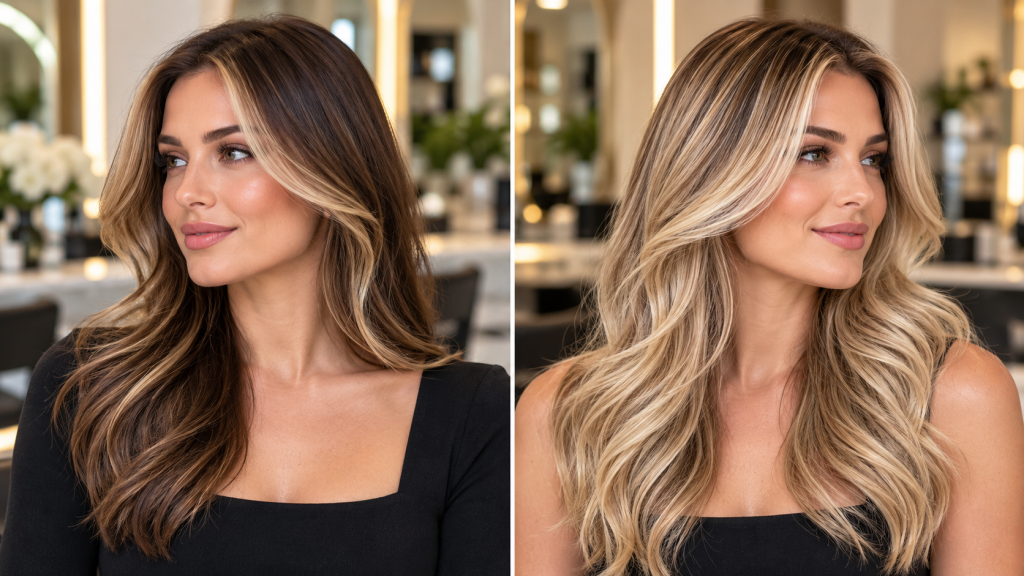
You know you want brighter, more dimensional hair. The harder question is whether that means booking full highlights or partial highlights. The difference is not simply “a lot of highlights” versus “a few highlights.” A full highlight places lightness through more areas of the head, including areas that become visible when the hair moves, lifts, or is worn up. A partial highlight concentrates brightness in selected areas—often around the face, hairline, crown, and top layers.
Neither is automatically better. Someone getting highlights for the first time may need a full service to build balanced dimension. Someone who already has well-placed highlights underneath may only need a partial refresh. And a person who mainly wants brightness around the face may not need the rest of the hair lightened at all.
Before booking hair highlights in Cincinnati, the better question is:
Where do you actually want to see the brightness?
Full vs. Partial Highlights: The Quick Answer
| If You Want… | Full Highlights | Partial Highlights |
| Brightness throughout the hair | Better starting point | May leave more natural depth underneath |
| A lighter overall appearance | Usually stronger choice | More targeted change |
| Brightness around the face and top | Can do this plus more | Strong fit |
| A refresh between larger appointments | May be more than needed | Often useful |
| More natural color left untouched | Less | More |
| Dimension visible when hair is worn up | Usually greater coverage | Depends on placement |
| A noticeable first-time change | Often suitable | Better for a softer change |
This is a starting point, not a booking rule. Existing color, natural hair, condition, density, and the amount of brightness already present can completely change the recommendation.
Think in Visibility Zones, Not Just Number of Foils
One of the easiest ways to understand the difference is to stop counting highlights and think about where the hair is visible. Imagine the head in three color zones.
Zone 1: Face and Hairline
These are the pieces people often notice first.
Brightness around the temples and front hairline can make a relatively small color service look surprisingly noticeable. A client who likes the overall color but feels dark around the face may need very little work outside this area.
Zone 2: Top and Crown
These sections are highly visible when the hair is worn down.
Partial highlights commonly concentrate here because strategically placed lighter pieces can create brightness without lightening every area underneath.
Zone 3: Sides, Back and Underneath
These areas become more important when the hair moves, is curled, pulled into a ponytail, half-up style, or updo.
This is where full highlights can make a significant difference.
| Hair Area | Partial Highlight | Full Highlight |
| Face/hairline | Usually prioritized | Included |
| Top/crown | Usually prioritized | Included |
| Sides | Selected placement | Broader placement |
| Back | May remain darker | More dimension throughout |
| Underneath | Often keeps more natural depth | More likely to be highlighted |
This is why two highlight services can look similar from the front but very different when the client turns around or pulls the hair up.
What Does a Full Highlight Actually Do?
A full highlight places lighter pieces through more areas of the head.
The goal is not to lighten every strand. Natural or darker hair remains between highlighted sections to create contrast and dimension. Full highlights may be useful when the client wants the hair to look brighter from multiple angles rather than primarily through the top.
Full Highlights May Make Sense When You Want:
- More overall brightness
- Dimension through the sides and back
- Lighter pieces underneath
- A bigger change from the current color
- More consistent brightness when wearing the hair up
- To rebuild highlight placement after significant grow-out
- A stronger blonde or dimensional effect throughout the head
A full highlight can still look soft and natural. “Full” describes coverage, not how bold every piece must be. Fine sections can create subtle blended lightness. More visible sections can create stronger contrast. If the real decision is between foil brightness and softer painted color, compare balayage vs. traditional highlights before deciding based only on coverage.
What Does a Partial Highlight Actually Do?
A partial highlight focuses the lightening where it will create the most useful change. That often means the top, crown, front hairline, or selected visible areas while leaving more natural depth elsewhere. This can make partial highlights useful for two very different clients:
The First-Time Highlight Client
Someone who wants to try dimension without making the whole head significantly lighter may prefer to begin with focused placement.
The Existing Highlight Client
This is where partial highlights become especially useful. If a previous full highlight still looks balanced through the underneath and back, those sections may not need to be lightened again. The next appointment can sometimes focus on the visible regrowth and brightness that actually need attention.
That is not “doing less” just to save time. It is avoiding unnecessary lightening where the existing color still works.
Your Existing Highlights May Decide More Than Your Goal
A common mistake is booking based only on the finished photo someone wants. The stylist also has to work with what is already in the hair.
Suppose the underneath still has plenty of lightness, but the top has grown out. A partial highlight may restore the visible brightness without rebuilding the entire color. Now consider someone who has:
- Significant natural growth throughout
- Darker areas underneath
- Very uneven old placement
- A new goal for much greater brightness
A partial highlight may leave the finished color incomplete from certain angles. This is why The Wild Hare Salon’s highlight service looks at starting color, previous highlights, desired brightness, and maintenance preference before determining placement.
Which One Will Make You Look More Blonde?
Usually, full highlights can create a lighter overall impression because more sections of the hair contain brightness. That means a partial highlight can still create a strong visual change when the lightness is placed where the eye sees it first.
If “Brighter” Is the Goal, Ask What That Means
Does brighter mean:
- More blonde around the face?
- A lighter top?
- More blonde everywhere?
- Less dark hair underneath?
- More contrast?
- Softer dimension?
- Cooler blonde?
- Less visible regrowth?
Those are different color goals. Showing inspiration photos is helpful, but explaining what you like about the photo is even better.
How You Wear Your Hair Should Affect Highlight Placement
This factor gets overlooked. Someone who wears long hair down almost every day sees mostly the surface, face frame, and top layers. Carefully placed partial highlights can create plenty of visible dimension.
Someone who frequently wears:
- Ponytails
- High buns
- Braids
- Half-up styles
- Formal updos
In that case, fuller placement can help the color look more connected when the hair moves. This is also where haircut and color should work together. Layers expose different areas of the hair, which can change how highlights appear. If the shape is changing too, coordinating color with a professional haircut can help the finished placement make more sense.
What About Fine Hair?
Fine hair does not automatically need partial highlights. Nor does it automatically need a full head of fine highlights. The goal should be to create enough contrast and movement without pushing the hair farther than its condition comfortably allows.
Thoughtful highlighting can create visual dimension because lighter and darker pieces sit next to one another. The haircut also affects how full the hair appears. For fine hair, a stylist may consider:
- How dense the hair is
- Whether the scalp becomes visible through certain sections
- Previous lightening
- How much contrast suits the natural base
- Whether the client wants volume, brightness, or both
- How the hair is normally styled
For someone whose main concern is actual fullness rather than just visual dimension, hair extensions may solve a different problem than adding more highlights.
What About Brunette and Dark Hair?
Partial highlights can work beautifully when someone wants to keep a strong brunette base. A few well-placed lighter sections may create movement without making the entire head feel blonde. Full highlights can make more sense when the goal is greater brightness throughout the hair.
The starting shade matters because dark hair reveals underlying warmth as it is lightened. Depending on the starting point and amount of lift, those underlying tones may appear red, copper, orange, gold, or yellow before toner helps refine the final result.
That is why the goal should not simply be:
“I want blonde highlights.”
A more useful conversation includes:
- How light?
- How much contrast?
- Warm, neutral, beige, or cool?
- How much brunette should remain?
- How often are you willing to maintain the result?
If softer brightness with more natural depth at the root sounds closer to the goal, balayage hair color may also be worth comparing.
Are Full Highlights More Damaging Than Partial Highlights?
Not automatically.
A full highlight exposes more selected sections to lightener during that appointment, but hair damage cannot be predicted simply from the service name.
What matters includes:
- Current hair condition
- Previous bleaching
- Whether existing lightened sections are overlapped
- Desired level of lift
- Product choice
- Processing
- Heat habits at home
- Frequency of future lightening
Repeatedly lightening hair that does not need more lightening can create unnecessary stress.
That is another reason a partial appointment can sometimes be the more strategic maintenance choice, rather than merely the smaller service.
Full vs. Partial Highlights Checklist
A Full Highlight May Be the Better Starting Point If:
You want brightness visible throughout the head.
The underneath currently looks too dark.
You wear your hair up often.
You are building a highlighted look from mostly natural hair.
Existing highlights have grown out through several areas.
You want a noticeably lighter overall appearance.
A Partial Highlight May Be Enough If:
You mainly want brightness around the face and top.
You like having more natural depth
Existing highlights underneath still look good.
You are refreshing a previous full highlight.
You want a smaller color change.
Your main concern is visible regrowth through the crown or hairline.
Book a Consultation First If:
You have box color.
Your hair has been bleached several times.
You are unsure what previous color is still in the lengths.
Your hair feels fragile or unusually dry.
You want a major change in one appointment.
You cannot tell whether you need highlights, balayage, or full color.
If the real choice is highlights versus changing the entire base shade, the guide to highlights vs. full hair color covers that separate decision.
Five Things to Tell Your Stylist Before Choosing
You do not need to walk into the salon knowing the exact service name. Instead, be ready to explain:
1. Where You Want to Look Brighter
Face? Top? Everywhere? Underneath too?
2. How Much Natural Color You Want to Keep
Some people love seeing deeper sections between the highlights. Others want the overall result much lighter.
3. How You Usually Wear Your Hair
Hair worn down reveals different sections from hair worn in ponytails or updos.
4. Your Color History
Include professional color, home color, lightening, balayage, and chemical services.
5. How Much Maintenance Fits Your Routine
The best-looking color is not a good fit if its upkeep becomes frustrating.
You can review the salon’s full service menu before booking if highlights will be combined with a haircut, extensions, smoothing, or another service.
FAQs About Full vs. Partial Highlights
Are full highlights better than partial highlights?
Neither is better for everyone. Full highlights add brightness through more areas of the hair, while partial highlights focus on selected visible sections. The right service depends on the current color, existing highlights, desired brightness, hair condition, and how the hair is worn.
Will partial highlights make my whole head look lighter?
They can make the hair look noticeably brighter from the front and top, especially when face-framing pieces are included. However, the underneath and some back sections may remain darker than they would with a full highlight.
Should I get a partial highlight after a full highlight?
Sometimes. If the underneath still has good dimension and the main regrowth is through the top or hairline, a partial service may be enough for the next appointment. A stylist should look at the current placement before deciding.
Are partial highlights good for brunettes?
Yes. Partial highlights can add caramel, beige, honey, blonde, or other dimensional tones while leaving more of the brunette base visible. The exact result depends on the starting color and how the hair lifts.
Do full highlights mean every piece of hair becomes blonde?
No. A full highlight places lighter pieces throughout more areas of the head, but darker or natural hair remains between them. The amount of contrast and brightness can be customized.
What is the difference between partial highlights and face-framing highlights?
A partial highlight covers selected sections of the head and may include the crown, top, sides, and face area. Face-framing highlights focus specifically on pieces near the face and hairline.
How do I know what highlight service to book?
Focus on the result instead of guessing the salon terminology. Explain where you want brightness, how light you want to go, what color is already in your hair, and how often you want maintenance. If the starting point is complicated, contact The Wild Hare Salon before choosing the appointment.