
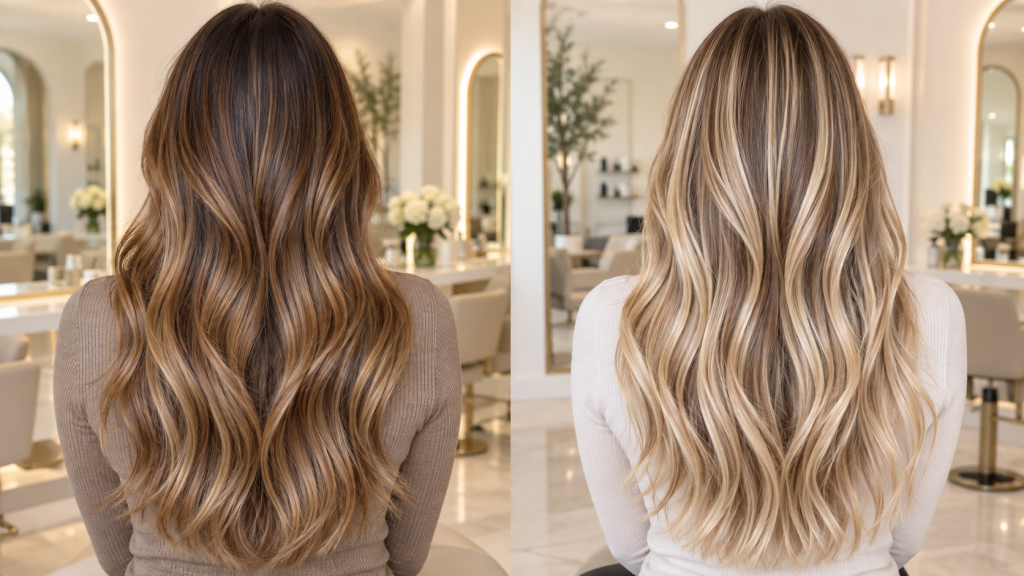
Balayage and highlights can both add brightness and dimension, but they create different effects. Balayage usually gives softer, more blended lightness with a lived-in grow-out, while traditional highlights can create brighter and more controlled lightness closer to the roots.
Neither option is automatically better. The right choice depends on your current color, previous hair services, how bright you want to go, and how much maintenance fits your routine. Understanding how the two techniques differ can make it easier to explain what you want during your next color consultation.
Balayage vs. Highlights at a Glance
| Factor | Balayage | Traditional Highlights |
| Application | Lightener is painted onto selected areas | Selected strands are usually processed in foils |
| Root appearance | Often keeps more natural depth | Can create brightness closer to the root |
| Finished look | Soft, blended dimension | Controlled, more structured brightness |
| Grow-out | Usually softer | Regrowth may appear more clearly |
| Placement | Customized freehand placement | Full, partial, or targeted placement |
| Best for | Lived-in color and natural dimension | Stronger brightness and defined placement |
| Maintenance | Depends on tone and contrast | Depends on placement and root brightness |
These are general differences rather than strict rules. Balayage can be bright, and highlights can be subtle. A colorist can adjust either technique based on the client’s starting point and desired result.
What Is the Main Difference Between Balayage and Highlights?
The biggest difference is how the lighter pieces are placed throughout the hair.
Balayage uses a freehand painting technique. Instead of separating every lighter section in the same way, the colorist selects where the brightness should sit based on the haircut, natural color, density, and desired result. This often creates a softer transition between the natural base and lighter mids or ends.
Clients considering this approach can learn more about balayage hair color in Cincinnati and how placement can be adjusted around the client’s current hair and color goals.
Traditional highlights usually involve separating selected strands and processing them in foils. Foils give the colorist greater control over how close the lightness begins to the root and how evenly brightness appears throughout the hair.
The Wild Hare Salon also provides more detail about hair highlights in Cincinnati for clients who prefer structured brightness or want to compare full and partial placement options. One point is often misunderstood: balayage is a coloring technique, not one specific shade or finished hairstyle. Brunettes, blondes, and darker hair colors can all use balayage placement differently.
Which Look Are You Trying to Create?
This is usually the best question to answer first.
Balayage may make more sense when you want to keep some natural depth near the roots and gradually add brightness through the rest of the hair. It is often chosen for softer, sun-kissed dimension or a lived-in appearance.
Highlights may make more sense when you want noticeable brightness starting higher on the head. They can also work well when you want lightness distributed more consistently instead of concentrating most of it through the mids and ends.
Someone wanting subtle caramel movement through brunette hair may prefer balayage. Someone hoping for a brighter blonde effect closer to the root may be better suited to traditional highlights. That does not mean the two techniques cannot overlap. In many cases, the final result may use more than one color technique.
Which Requires More Maintenance?
Balayage often has a softer-looking grow-out, but that does not mean it is maintenance-free.
Because balayage commonly keeps more natural color near the roots, new growth may blend more gradually. Traditional highlights placed close to the scalp can show a clearer difference between new growth and previously lightened hair. However, root growth is only one part of color maintenance.
Lightened hair can also change tone between appointments. Blonde or lighter sections may gradually become warmer, duller, or less balanced. A toner or gloss may help refresh the shade even when another full lightening appointment is not yet needed. This means maintenance may sometimes involve a smaller color refresh rather than repeating the entire balayage or highlighting process.
Pro Tip
Think about two kinds of maintenance: lightening maintenance and tone maintenance.
Your hair may not need more lightener, but you may still want a toner, gloss, face-framing refresh, or root adjustment to keep the overall color looking closer to the result you prefer.
Does Balayage or Highlighting Cause More Damage?
Neither technique is automatically more damaging.
Both services may involve lightener, so the condition of the hair and the amount of processing matter more than the name of the service. Previously bleached hair, repeated overlap, aggressive lifting, and frequent lightening can place additional stress on the hair. A client with healthy untreated hair may therefore have very different options from someone whose hair has already been lightened several times.
This is why previous color history matters. Even when older dye is no longer obvious, it can still affect how the hair responds during another lightening appointment. Clients who have also received a keratin smoothing treatment should mention that during their color consultation. Previous smoothing and chemical services can be useful information when the stylist reviews the hair’s history.
Balayage vs. Highlights for Brunette or Dark Hair
Both techniques can work well on brunette and dark hair.
Balayage can help preserve a deeper natural base while introducing lighter pieces through selected areas. Depending on the starting color and desired result, the finished look may include caramel, honey, beige, bronde, or other dimensional tones.
Traditional highlights may work better when the goal is stronger brightness throughout the hair. Because the colorist can control each section closely, foils can be useful when more consistent lightness is wanted from higher on the head.
Dark hair often reveals warmer underlying tones as it lightens. The final shade therefore depends on the starting color, how much lift is achievable, and how the lightened areas are toned afterward.
What About Fine or Thin Hair?
Fine hair does not automatically need balayage instead of highlights, or vice versa. The goal is usually to create movement and dimension without overwhelming the hair with too much contrast or processing. Carefully placed lighter pieces can help create visual depth, while the haircut itself can also influence how full or dimensional the finished style appears.
For someone planning both color and a shape change, it can make sense to coordinate the color with a haircut that complements the finished look. Layers, face framing, or a different overall shape may change where lighter pieces look most effective.
Is Balayage or Highlights Better for Gray Hair?
That depends on whether the goal is gray blending or complete gray coverage. Highlights can sometimes soften the contrast between gray strands and darker natural hair by adding lighter pieces around them. Balayage may also add dimension, but it is not automatically a gray-coverage service.
Someone who wants complete gray coverage may need another color service in addition to highlights or balayage. The goal should therefore be discussed before the appointment. Blending gray and covering gray are not the same thing.
Can You Combine Balayage and Highlights?
Yes. You do not always have to choose only one technique.
A colorist might use balayage through the mids and ends while placing brighter foil pieces around the face. Fine babylights may be added through the top, while a root melt can create a softer transition between the natural color and lighter sections.
This type of combination can be useful when one technique alone cannot create the exact placement or brightness the client wants. It also explains why two people can both say they have “balayage” while their final results look very different.
Balayage vs. Highlights: What About Cost?
There is no single answer because pricing depends on the amount of work involved. Hair length, density, starting color, previous color, desired brightness, corrective work, and the amount of product required can all affect the appointment.
A detailed balayage may take considerable time because the placement is customized. A full head of fine highlights can also require significant time and product. It is useful to consider more than the cost of the first appointment. Maintenance frequency can affect the longer-term expense as well. Someone with softer grow-out may go longer between major lightening appointments, while someone who prefers brightness close to the root may choose more frequent maintenance.
Because every starting point is different, discussing the service and expected maintenance before booking gives a clearer picture than comparing the names of the services alone.
What Should You Discuss During a Color Consultation?
A good color consultation should focus on the finished result rather than only the service name.
Talk about your current hair color, previous color history, how light you want to go, how often you want to return to the salon, and the tones you like or dislike. Inspiration photos can help, especially when you explain exactly what you like about them.
It is also useful to discuss your daily styling routine. Some color placements appear differently on straight hair than they do on waves or curls.
At The Wild Hare Salon, clients considering dimensional color can compare both balayage hair color in Cincinnati and hair highlights in Cincinnati before deciding which direction better fits their goals.
So, Should You Choose Balayage or Highlights?
Choose the technique based on the result you want.
Balayage may be the better fit if you want soft dimension, natural root depth, and a blended grow-out. Highlights may work better when you want brighter lightness, more defined placement, or color beginning closer to the roots.
Some clients may benefit from a combination of both.
Your starting color, previous processing, hair condition, and preferred maintenance schedule should guide the final decision. A consultation gives the stylist a chance to see your hair in person before recommending the most practical approach.
You can also explore other hair salon services in Cincinnati if your color plan includes a haircut, styling, smoothing service, or another salon appointment.
FAQs About Balayage vs. Highlights
Is balayage better than highlights?
Neither is automatically better. Balayage often works well for softer, blended dimension, while highlights can create more controlled brightness closer to the root. The better option depends on your starting color, desired result, and maintenance preference.
Does balayage last longer than highlights?
Balayage often has a softer-looking grow-out because more natural depth may remain near the roots. However, toner, gloss, or brighter face-framing sections may still need refreshing before another full lightening service.
Is balayage more expensive than highlights?
It can be, but there is no fixed rule. Hair length, density, starting color, previous color, placement, and the time required can all affect pricing. Long-term maintenance should also be considered.
Is balayage or highlighting more damaging?
Neither technique is automatically more damaging. Hair condition, previous processing, product overlap, the amount of lift required, and how often the hair is lightened matter more than the service name.
Is balayage or highlights better for dark hair?
Both can work on dark hair. Balayage may preserve more natural depth, while traditional highlights can create stronger and more evenly distributed brightness.
Can balayage and foil highlights be combined?
Yes. A colorist may combine painted balayage with foil highlights, babylights, face-framing pieces, toner, or a root melt when a mixed approach better fits the desired result.
What should I book if I cannot decide between balayage and highlights?
Start with a color consultation or contact the salon before choosing. Your current color, previous chemical services, hair condition, desired brightness, and maintenance preferences can help determine the right service.